Henry
Henry computes the resistance and the propulsion power of symmetrical monohull ships.
Introduction
The main features are:
- The total resistance (pressure resistance plus an empirically determined friction resistance), the wave pattern and the pressure distribution on the hull are calculated. Appendages and openings in the hull are not directly taken into account in the flow calculation. However, their flow forces are estimated using empirical coefficients. Particularly, the frictional resistance of rough hull surfaces is treated in detail.
- The mesh generation on the hull and water surface is largely automated.
- The non-linear boundary condition at the water surface is solved iteratively.
- The program is suitable for ships with and without transoms and with and without bulbous bows; it can be used for Froude numbers between approximately 0.2 and 0.7. Calculations can be performed in deep or shallow waters as well as in channels.
- The dynamic trim and sinkage are calculated.
- The linearised resistance changes with shape changes are calculated.
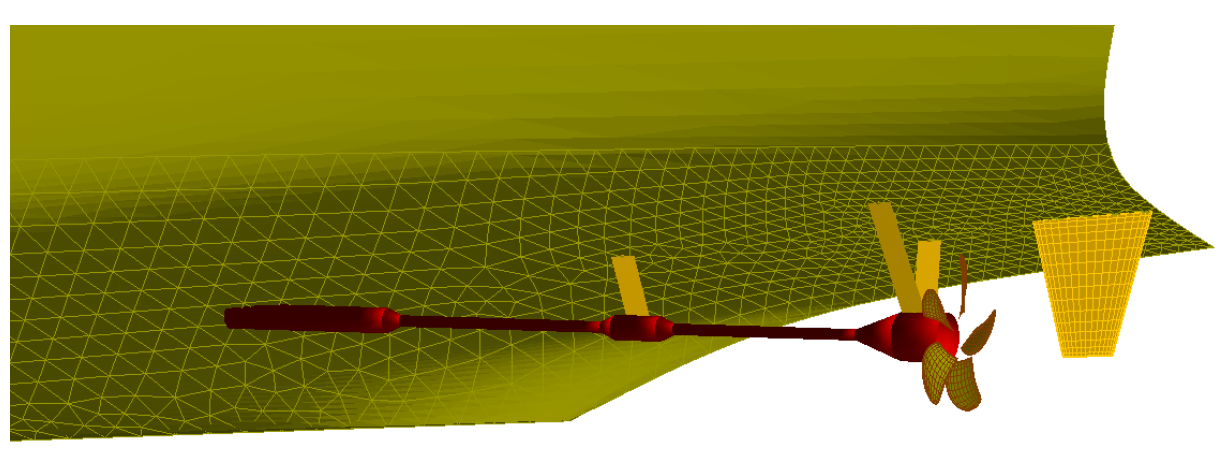
Furthermore, the forces (in particular the resistance) at the appendages and caused by the air are taken into account. Currently, thrusters, bilge keels, shaft lines and shaft brackets, the flow separation at propeller hubs, and the resistance and lateral force of rudders are accounted for. A proven vortex grid method is used to calculate the rudder and propeller flow which captures the effect of the propeller on a rudder and also approximately the interaction between the propeller and the hull.
Results
Figures 1-3 show input grids of hull and appendages and computed wave pattern.


References
[1] Schumann C.: The validation of potential theory based predictions of full scale resistance and propulsion characteristics; NuTTS 2021, Mülheim an der Ruhr, Germany