Strip
Introduction
The calculation program underlying the Strip module is based on the well-known ‘strip method’. This program is called UTStrip, was developed by Professor Söding and is an extension of the public domain code PDStrip [1, 2]. The user interface and this program are referred to as Strip in the following. The strip method is based on the assumption that the ship’s hull is slender and that the hydrodynamic forces depend linearly on the wave height. Due to the assumed slenderness, the ship’s hull can be divided into a discrete number of two dimensional sections. Only the ship’s shape below the still water waterline is considered.

In a first step, the hydrodynamic forces of each section are calculated in regular waves. Hydrodynamic forces are wave excitation forces and radiation and diffraction forces. The wave excitation forces consist of the pressure distribution in the incoming undisturbed wave and the forces caused by the disturbed wave acting on the stationary ship. These radiation forces are formulated as additional mass and damping forces acting on the moving ship. The total hydrodynamic forces of the ship are determined by integrating the forces of all individual sections over the length of the ship. The equations of motion are then solved to calculate the transfer functions (RAO) for the ship’s motion and other specific values at given wave encounter angles and ship speeds.
In the final step, the statistical motion values for seaways are calculated using the transfer functions obtained and the seaway spectrum S(ω) of the irregular seaway under consideration.
Based on the calculated relative motions (vertical distance between the water surface and the ship’s fixed point), the occurrence of water on deck, slamming and propeller immersion is determined. The effects of reflected or radiated waves on the relative motions are therefore not taken into account. However, to determine the occurrence of water on deck and the additional resistance in waves, the calculated relative motions are slightly modified using an HSVA approach to roughly take into account the effect of reflected and radiated waves.
Since UTstrip based on potential theory neglecting viscous effects, Strip increases roll damping by means of additional roll damping coefficients derived from model test results with similar hull shapes or determined using the module Ikeda.
In addition, the roll-damping effects (and effects on other degrees of freedom such as yaw) of the following appendages and installations can be taken into account in Strip:
- Bilge keels and box keels,
- passive or actively controlled rudders and fin stabilisers,
- Zero speed fin stabilisers using a simplified approach,
- U-shaped and free-surface anti-roll tanks and
- external forces that depend on the motion of the ship.
By incorporating these various roll damping measures, it is generally possible to achieve a fairly accurate prediction of the ship’s roll behaviour. A series of wizards assists the user in entering the various roll damping measures.
Strip can calculate symmetrical twin-hull vessels, taking into account the interaction of waves between the hulls. The water can be deep or shallow, but the water depth is constant in space and time.
The effects of wind and current are not taken into account. Phenomena such as parametric rolling and loss of stability on the wave crest cannot be captured by linear seakeeping method. However, the module Rolf can investigate these phenomena.
Results
In general, the following outputs are available:
- Motion in the 6 degrees of freedom,
- absolute and relative motions, velocities and accelerations at monitoring points,
- accelerations in the ship-fixed coordinate system at monitoring points,
- motion-induced interruptions (MII) and seasickness (MSI) at monitoring points,
- water on deck, bottom slamming and propeller immersion at monitoring points and
- drift forces and added resistance in waves.
Linear seakeeping methods have limitations that must be taken into account. Nevertheless, the program can be used for a wide range of investigations. Common applications include, for example:
- Investigation of general seakeeping behaviour,
- comparison of different hull geometries,
- identification of operating conditions (combination of seaway, encounter angle and ship speed) that lead to strong ship motions,
- investigation of the effectiveness of different configurations of roll damping devices,
- creation of operating diagrams (OPI) based on specified limit criteria and
- preparation of ship motion data for use in long-term studies with the module LongTerm.
Examples
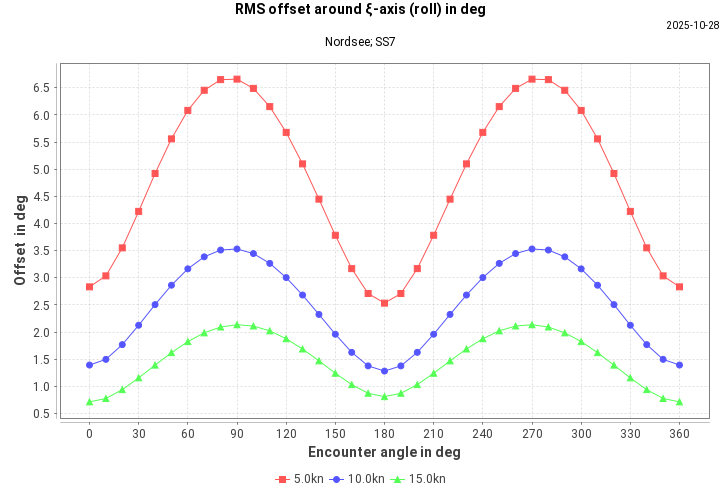
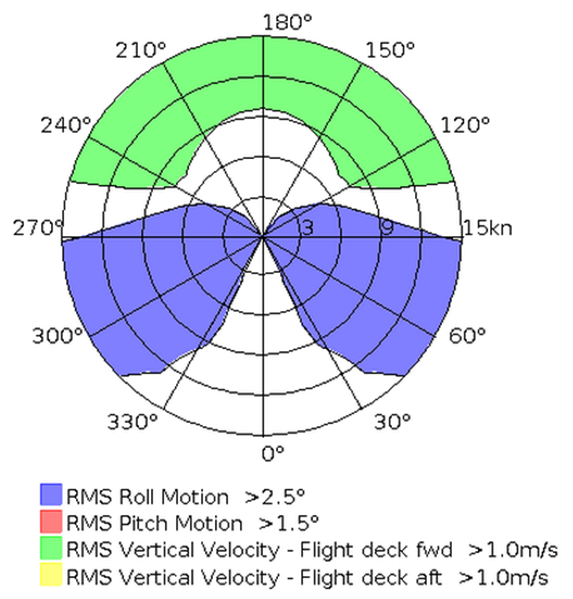
Figures 2 and 3 show two typical examples.
References
[1] Söding H., Bertram V.: Program PdStrip: Public Domain Strip Method, April 2009.
[2] Söding H.: UTStrip: Strip method for Program System Uthlande, July 2015.