SiS
SiS simulates ship motions and loads in its cross sections, either in a single nonlinear regular wave, or in a linear superposition of many regular waves on deep or shallow water.
Introduction
The program is confined to symmetrical single-hull bodies with or without steady forward speed. The hull may be rigid, or it may be elastic performing vibrations.
SiS uses a panel method and solves the non-linear boundary condition of the free surface in the near field of the hull. The algorithm treats six degrees of freedom completely non-linearly.
The theory, the validation of the computational kernel of this module can be found in Söding [1, 2, 3, 4] and the following text is quoted from [1]:
”Accurate predictions of ship motions and loads in a steep seaway require to include contributions depending non-linearly on wave amplitude. CFD methods do that routinely, but they require very high computing effort. Previous potential methods neglect either all or at least some non-linear effects. SiS includes all substantial non-linear effects amenable to potential flow. Using approximations for effects of flow separation at the aft end of hull and rudder, an accuracy comparable to that of good model experiments and CFD calculations is attained. That is demonstrated for motions and loads in cross sections of a containership sailing in head and quartering waves of large amplitude.
A number of new ideas which were necessary to obtain a robust and accurate, fully non-linear procedure are described. In typical cases, the method may take only one or a few percent of the computing effort of a comparable CFD computation.”
Application and results
The application of SiS is primarily in simulations where any non-linear effects are of importance.
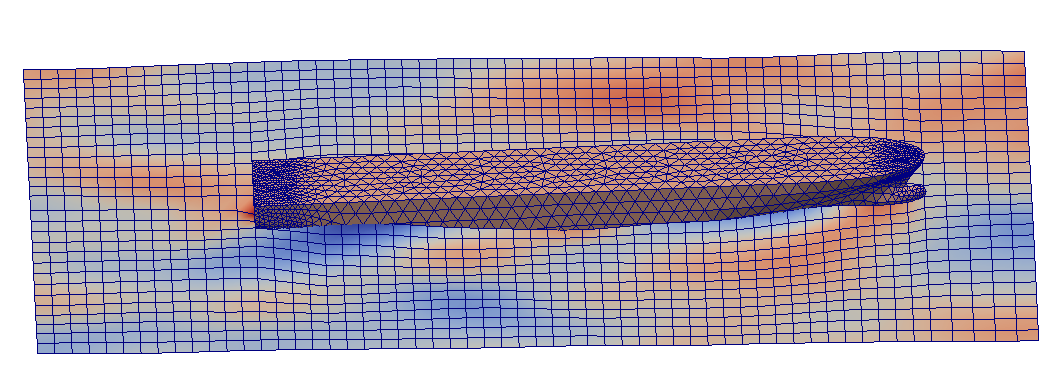
Results of SiS are mainly time series of ship motions in all degrees of freedom, in waves, long- or short-crested seaways. Additional possible outputs are motion displacements, velocities and accelerations in user-defined locations, pressure on the hull and animations of the flow and motion.
The figures 1 to 3 show some example of the results.


References
[1] Söding H.: Fast accurate seakeeping predictions; Ship Technology Research Schiffstechnik Vol. 67 3, 2020, pp. 121-135
[2] Söding H.: Program Sis – Ship in a Seaway, Version 1.2, 2022.
[3] Söding H.: Nonlinear seakeeping analysis of an elastic ship hull using potential methods; NuTTS 2021, Duisburg.
[4] el Moctar B.O., Schellin T.E., Söding H.: Numerical methods for seakeeping problems; Springer ISBN: 978-3-030-62560-3, 2021.